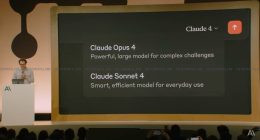

Anthropic has now released Claude Opus 4.6, describing it as its “smartest model’ to date and bringing gains in coding, long-horizon planning, code review, debugging, and sustained performance on complicated, multi-step tasks. It also introduces a 1-million-token context window in beta for Opus-class models, marking the first time that capacity has been available at this tier.
Claude Opus 4.6 is immediately accessible for Pro, Max, Team, and Enterprise plan subscribers, as well as through the Anthropic API and major cloud marketplaces. Pro remains priced at $20 per month (or $17 with annual billing), though Opus usage continues to be rate-limited. Once the limit is reached, users must wait several hours for the quota to reset.
The new model leads several public benchmarks, according to Anthropic’s official statement. It achieves the highest score on Terminal-Bench 2.0 (agentic coding in realistic terminal environments), tops Humanity’s Last Exam (multidisciplinary reasoning across academic disciplines), and outperforms OpenAI’s GPT-5.2 by roughly 144 Elo points and its own predecessor, Claude Opus 4.5, by 190 points on GDPval-AA, a test of economically valuable knowledge work in finance, legal, consulting, and related domains. Anthropic also reports strong results on BrowseComp (locating hard-to-find information online) and low rates of misaligned behavior, such as deception or unnecessary refusals.
“We’re upgrading our smartest model. The new Claude Opus 4.6 improves on its predecessor’s coding skills. It plans more carefully, sustains agentic tasks for longer, can operate more reliably in larger codebases, and has better code review and debugging skills to catch its own mistakes. And, in a first for our Opus-class models, Opus 4.6 features a 1M token context window in beta. Opus 4.6 can also apply its improved abilities to a range of everyday work tasks: running financial analyses, doing research, and using and creating documents, spreadsheets, and presentations. Within Cowork, where Claude can multitask autonomously, Opus 4.6 can put all these skills to work on your behalf,” the firm announced in its official statement.
The release of Claude Opus 4.6 by Anthropic could potentially accelerate the adoption of AI in enterprise settings, particularly in coding, financial analysis, and complex knowledge work, where its enhanced planning, debugging, and long-context reasoning address key pain points like error-prone outputs and scalability in large codebases. This comes at a time when enterprise and agentic AI have been the latest focus of tech firms. For example, this month saw the release of OpenAI’s Frontier platform, which focuses on orchestrating AI agents across enterprise workflows to enable seamless integration with existing systems and third-party models.
Anthropic positioned the release as a direct response to the demands of professional software engineers and knowledge workers who need models that can reliably handle large codebases, reason through ambiguous requirements, and self-correct during long tasks. The model is said to plan more deliberately than Claude Opus 4.5. According to the firm, the new model enables agent teams to work in concert, summarize its own context, and comes with what Anthropic calls adaptive thinking – “where the model can pick up on contextual clues about how much to use its extended thinking.”
Alongside this, Anthropic introduced complementary features Agent Teams and a preview of Claude in Powerpoint. The former lets multiple agents coordinate on a single objective. Each agent owns a discrete portion of the work, communicates results, and recovers from errors independently. The feature is available now for API and subscription users. The latter enables Max, Team, and Enterprise customers to read slide masters, corporate templates, fonts, and layouts directly inside Microsoft PowerPoint. Users can ask the model to restructure narratives, convert bullet points into diagrams, generate full decks from outlines, or maintain brand guidelines without leaving the application.
The Tech Portal is published by Blue Box Media Private Limited. Our investors have no influence over our reporting. Read our full Ownership and Funding Disclosure →

Soumyadeep is a Reporter at The Tech Portal, reporting on startups, AI and new tech. His focus is on covering startups developing cutting-edge technology across emerging sectors such as Deep-Tech, AI among others.