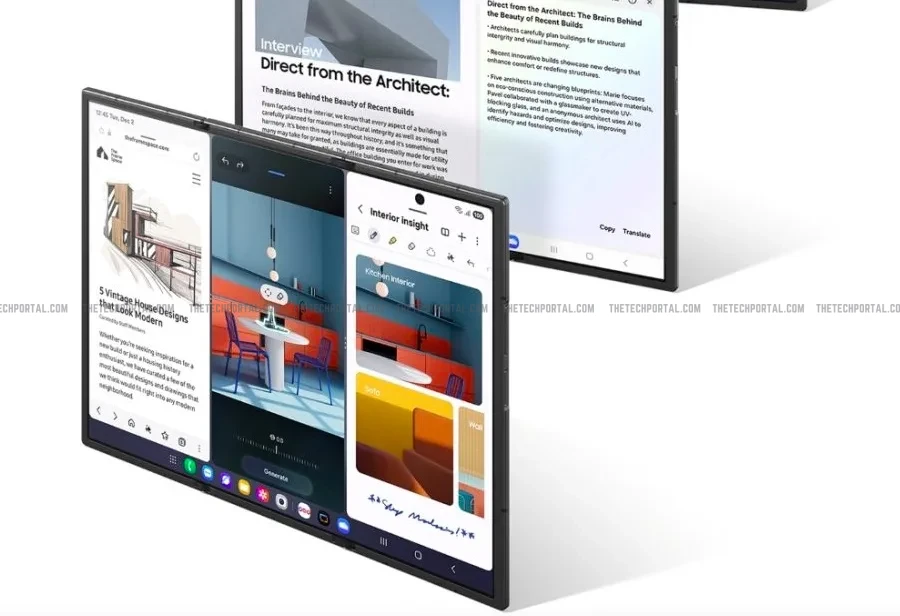

With losing share in the not so buoyant foldable space, and an imminent iPhone fold launch on the horizon, Samsung has stepped into a new era of mobile design with the debut of its first multi-fold smartphone – a triple-panel device that unfolds into a full 10-inch tablet and folds back down to a regular 6.5-inch phone.
Introduced as the ‘Galaxy Z TriFold’, the device is built around dual hinges, a lightweight titanium chassis, and a flexible display that the electronics giant says can withstand the stress of multi-stage folding. Samsung claims its dual-rail hinge architecture improves durability, stability, and long-term wear resistance. The firm is offering the Galaxy Z TriFold in a single black variant with 16GB of RAM and 512GB of storage, priced at ₩3,594,000 (~ $2,500).

Instead of relying on a single hinge and one large internal display, the TriFold uses two coordinated folding points to transform the device between phone, tablet, and hybrid modes. The engineering challenge behind this setup is significant – each hinge must distribute pressure evenly across the ultra-thin glass layers and OLED panels, while maintaining alignment across all three sections. When opened to its full 10-inch spread, the TriFold behaves much like a compact tablet. It supports a three-window multitasking system, allowing users to run multiple apps in parallel, and Samsung’s DeX desktop interface can now run natively on the device without a monitor.
Under the hood, the tech titan has loaded the TriFold with top-tier hardware. The device runs on Qualcomm’s latest Snapdragon 8-series ‘Elite’ platform, backed by 16 GB of RAM and high-speed UFS storage. The camera system is also designed to match the device’s high-end positioning, with a 200-megapixel primary sensor serving as the core of the rear triple-camera setup. It is supported by an ultrawide camera and a telephoto module that offers 3× optical zoom. For front-facing use, the phone includes two 10-megapixel cameras (one built into the cover display and another inside the main foldable screen).
Powering the entire setup is a 5,600 mAh multi-cell battery, currently the largest ever used in a Samsung foldable. Notably, the multi-cell structure is required because of the device’s segmented design. Fast charging and wireless charging are both supported, although Samsung has not introduced any new charging standards with this release. The Galaxy Z TriFold will debut in South Korea, Samsung’s home market. The company plans to extend availability to China, Singapore, Taiwan, and the UAE shortly thereafter, with the US market set to receive the device in early 2026.
The timing of this launch becomes noteworthy as the foldable smartphone market is showing clear signs of rapid growth and intensifying competition. In 2025, global shipments of foldables are estimated to reach around 20 million units, representing about 1.5-2% of the total smartphone market. While Samsung has long been the category leader, its share of global foldable sales has faced pressure from Chinese competitors, like Huawei, Xiaomi, and Honor, which together now account for more than 40% of the segment.
The Tech Portal is published by Blue Box Media Private Limited. Our investors have no influence over our reporting. Read our full Ownership and Funding Disclosure →