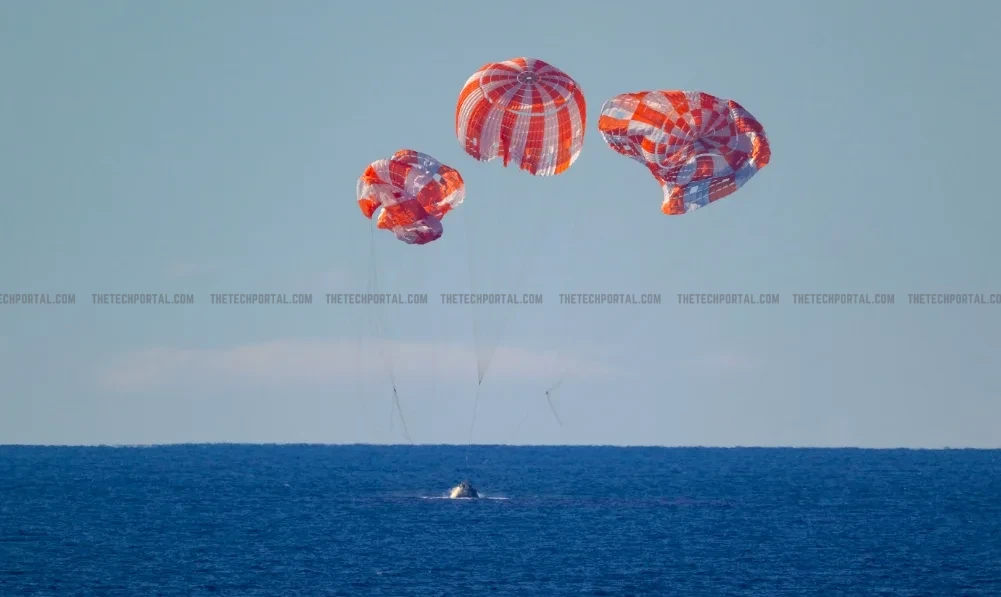
NASA’s Artemis II mission has successfully concluded with a precise ocean splashdown. The Orion spacecraft carrying Commander Reid Wiseman, Pilot Victor Glover, Mission Specialist Christina Koch and Canadian astronaut Jeremy Hansen landed in the Pacific Ocean off the coast of San Diego at 5:07 pm PDT (~ 8:07 pm ET) on April 10, completing a nearly 10-day journey around the Moon.
The splashdown was described by NASA as a ‘textbook’ and ‘bullseye’ landing, with the capsule touching down within its targeted recovery zone after a high-precision descent. Recovery teams, including US Navy personnel aboard the USS John P. Murtha, quickly secured the spacecraft and transported the astronauts for medical evaluation. NASA officials confirmed that all four crew members were in ‘green condition’, a term indicating no major medical concerns after spaceflight.
The mission itself is being widely described as the first human trip to the Moon since 1972, when the Apollo program ended, making Artemis II a defining milestone in modern space exploration. During the flight, Orion travelled a total distance of around 694,000 miles (over 1.1 million km) and reached a maximum distance of about 252,756 miles from Earth, breaking records set during Apollo missions.
Technically, Artemis II was designed as a full end-to-end systems test of NASA’s deep-space capabilities. The spacecraft followed a free-return trajectory, looping around the Moon and using its gravity to guide the capsule back to Earth. At closest approach, the astronauts passed about 4,000 miles above the lunar surface, observing and photographing regions of the Moon that had never been seen directly by humans.
The most dangerous phase of the mission came during Earth re-entry. Orion plunged into the atmosphere at speeds of around 25,000 miles per hour (over 40,000 km/h) – almost 32 times the speed of sound – while temperatures outside the capsule increased to about 5,000°F (~ 2,760°C). This intense heating created a plasma sheath around the spacecraft, causing a communications blackout lasting about six minutes. After peak heating, Orion deployed parachutes, slowing from hypersonic speed to about 19 mph (~ 30 km/h) before splashdown.
Meanwhile, Artemis II also made history through its crew. Christina Koch became one of the first women to travel to the Moon and back, Victor Glover became the first person of colour on a lunar mission, and Jeremy Hansen became the first non-American astronaut to reach the Moon’s surroundings. Notably, the success of Artemis II now sets the stage for Artemis III, which is expected to attempt a crewed Moon landing later in the decade. Beyond that, NASA plans to establish a sustained human presence on and around the Moon, using it as a base for future missions to Mars.
The Tech Portal is published by Blue Box Media Private Limited. Our investors have no influence over our reporting. Read our full Ownership and Funding Disclosure →

Ashutosh is a Senior Writer at The Tech Portal, largely reporting on new tech, and intersection of technology and business. Ashutosh’s career spans across nearly a decade of technology writing across multiple platforms and languages.