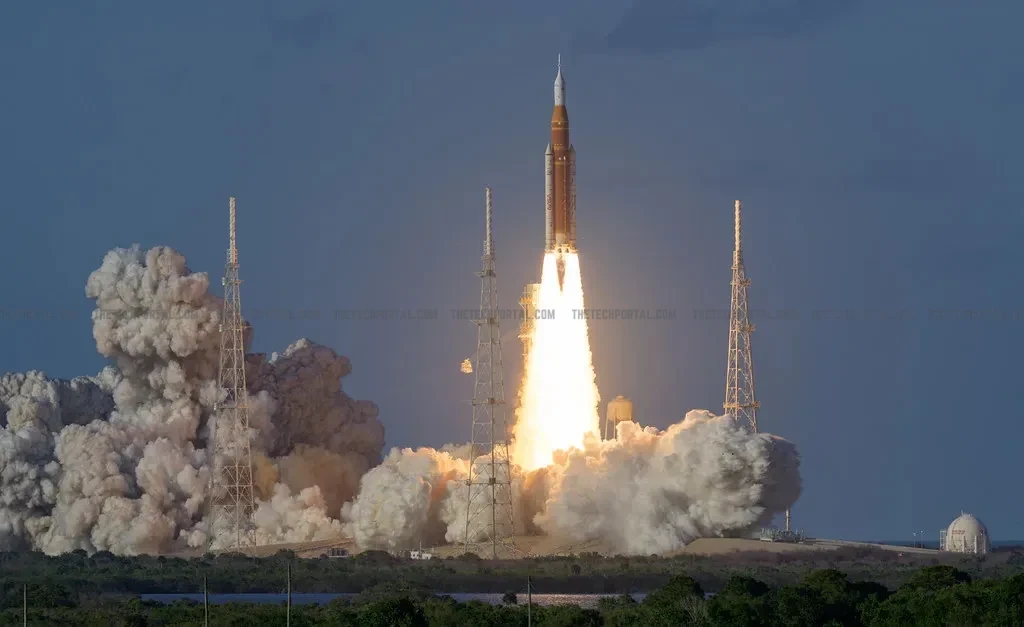
NASA’s Space Launch System (SLS) rocket, carrying the Orion spacecraft and a four-person international crew, lifted off from Launch Complex 39B at 6:35 PM EDT on April 1, initiating the Artemis II mission (the first crewed flight beyond low Earth orbit since Apollo 17 in 1972). The vehicle, generating approximately 8.8 million pounds of thrust from its twin solid rocket boosters and four RS-25 engines, propelled the 5.75-million-pound stack skyward.
The crew — Commander Reid Wiseman, Pilot Victor Glover, Mission Specialist Christina Koch (all NASA), and Mission Specialist Jeremy Hansen of the Canadian Space Agency — took to the stars aboard the Orion capsule, named “Integrity.” As the rocket cleared the launch tower and transitioned to autonomous flight after umbilical detachment, Wiseman radioed back with enthusiasm: “Great view…It is amazing to be at this altitude.” Moments later, he added observations of Earth from the rising vantage point, describing views of Australia as “epic.”
NASA officials reported the crew as “safe, secure, and in great spirits” shortly after reaching initial orbit. The roughly 10-day test mission will not land on the Moon but instead follow a free-return trajectory that takes the astronauts around the lunar far side—potentially farther from Earth than any humans have traveled before — before splashing down in the Pacific Ocean. “Let me begin by congratulating the team at NASA and our brave astronauts on the successful launch of Artemis 2,” US President Donald Trump congratulated NASA at a national address. “It was quite something.” Still, the lead-up to launch was not entirely smooth. Pre-flight technical issues required troubleshooting, but the team achieved “go for launch” status within the window.
Artemis II represents a pivotal milestone in NASA’s Artemis program, which aims to establish a sustainable human presence on the Moon as a stepping stone to eventual Mars exploration. It is the first crewed test of the SLS rocket and Orion spacecraft combination, validating systems critical for future lunar landings, including Artemis III (targeted for crewed surface operations) and subsequent missions. Christina Koch becomes the first woman to fly on a lunar mission, Victor Glover the first person of color, and Jeremy Hansen the first non-American astronaut on a journey beyond low Earth orbit. The mission builds directly on the uncrewed Artemis I flight in 2022, which successfully tested Orion’s heat shield, propulsion, and navigation during a lunar flyby. Artemis II introduces human factors (life support systems, manual piloting demonstrations, and real-time crew observations) while pushing the boundaries of deep-space operations.
The countdown proceeded with only minor technical issues resolved pre-launch, including brief communication and battery concerns. At liftoff, the SLS performed flawlessly. After booster separation and core stage main engine cutoff, the interim cryogenic propulsion stage took over, placing Orion into an initial elliptical Earth orbit. Approximately 49 minutes into the flight, the upper stage executed a burn to raise the orbit further. The crew then began system checkouts while Orion’s four solar array wings — extending to a 63-foot wingspan and mounted on the European Service Module—successfully deployed, providing power for life support, avionics, and communications through thousands of solar cells that track the Sun.
The spacecraft is scheduled to remain in high Earth orbit for roughly 24 hours, allowing the crew and ground teams to conduct thorough verifications of all systems. If performance remains nominal, controllers will command a translunar injection burn on April 2, sending Orion on its multi-day journey toward the Moon. A lunar flyby is planned for around April 6, during which the astronauts will pass within several thousand miles of the lunar surface. Following the flyby, lunar gravity will slingshot Orion back toward Earth for a Pacific Ocean splashdown around April 10–11.
The Tech Portal is published by Blue Box Media Private Limited. Our investors have no influence over our reporting. Read our full Ownership and Funding Disclosure →

Soumyadeep is a Reporter at The Tech Portal, reporting on startups, AI and new tech. His focus is on covering startups developing cutting-edge technology across emerging sectors such as Deep-Tech, AI among others.