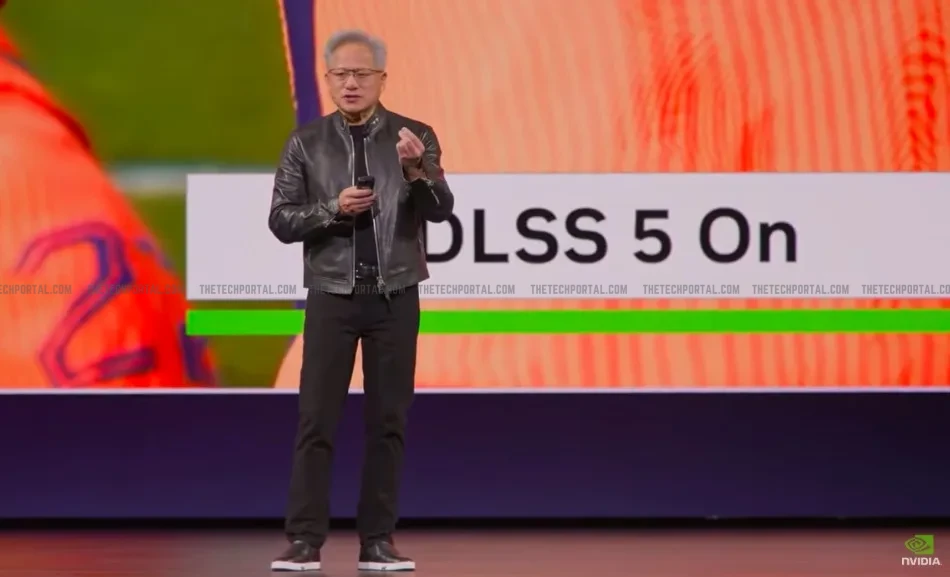

Nvidia has revealed DLSS 5, its next-generation AI graphics technology, during GTC 2026. Unlike earlier versions, which focused on upscaling and frame generation, DLSS 5 uses neural rendering, allowing AI to create or enhance visual elements like lighting, textures, and reflections in real time. The company’s CEO, Jensen Huang, introduced the technology, which runs on RTX GPUs with Blackwell architecture, combining AI and ray-tracing cores to deliver cinematic-quality graphics without overloading the GPU. The latest version is scheduled to launch in the second half of 2026.
Previous iterations of DLSS focused on improving performance through AI upscaling and frame generation. For example, DLSS 1 required per-game training, while DLSS 2 introduced generalized AI models that could be applied across multiple games. DLSS 3 added frame generation to insert additional frames, improving smoothness in real time, and DLSS 4 and 4.5 further improved these techniques using transformer-based AI models capable of producing multiple frames per rendered frame. But now, DLSS 5 goes beyond enhancement, integrating AI directly into the graphics workflow itself.

“DLSS 5 is the GPT moment for graphics — blending handcrafted rendering with generative AI to deliver a dramatic leap in visual realism while preserving the control artists need for creative expression,” Jensen Huang said.
The core innovation behind DLSS 5 is neural rendering, a process where AI models are trained on extensive datasets of high-quality rendered scenes and can then generate visual elements in real time during gameplay. DLSS 5 is designed to fully leverage the capabilities of Nvidia’s Blackwell architecture RTX GPUs, including the RTX 50-series. These GPUs feature 5th-generation Tensor Cores for AI calculations and 4th-generation ray-tracing cores for advanced lighting simulations, enabling seamless integration of neural rendering with ray tracing. By combining AI with traditional GPU processing, DLSS 5 can maintain high frame rates even in graphically demanding games.
The introduction of neural rendering also signals a broader shift in the gaming and graphics industry. While competitors like AMD with FidelityFX Super Resolution (FSR) and Intel with XeSS have focused primarily on AI-assisted upscaling, Nvidia is integrating AI directly into the generation of graphics.
Nvidia claims that the technology allows developers to create larger, more immersive game worlds while optimizing GPU performance. Even the company’s vision with DLSS 5 is not limited to gaming alone. The technology could have implications for virtual production, cinematic rendering, and real-time simulation, where generating high-fidelity visuals in real time has traditionally required extremely powerful hardware.
The Tech Portal is published by Blue Box Media Private Limited. Our investors have no influence over our reporting. Read our full Ownership and Funding Disclosure →