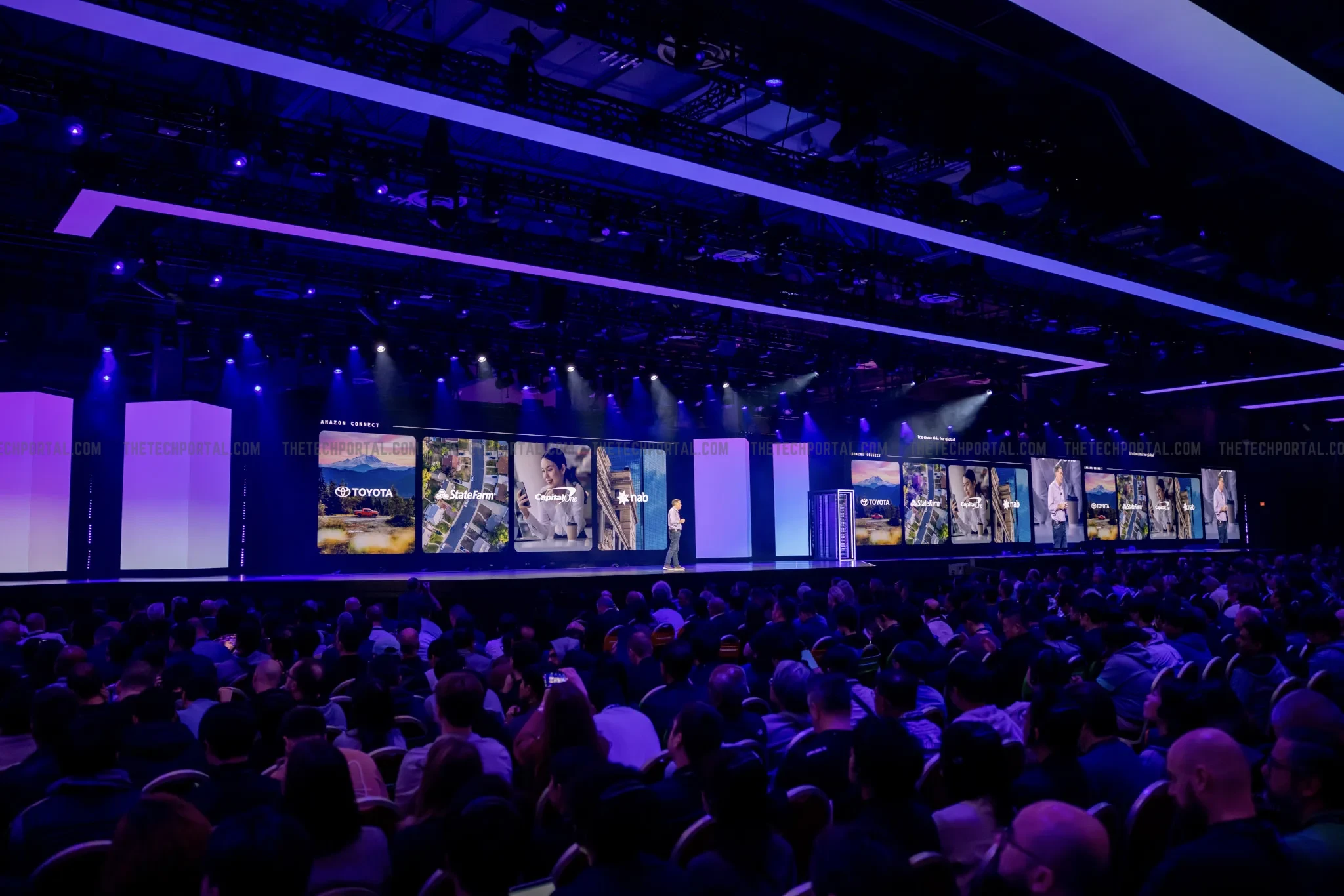

Amazon has taken big strides when it comes to AI, and AI hardware in particular. The e-commerce giant is betting big on AI to compete with the likes of OpenAI, Microsoft, Google, and it’s recent AWS re:Invent Las Vegas summit was a perfect template of what is about to come.
The event, attended by tens of thousands of engineers, executives, and researchers, revealed Amazon’s intent to reposition AWS around agentic AI, heightened security controls, and a more automated operational model for large-scale enterprises.
A primary theme was the push toward agentic systems—AI that can execute multi-step actions, not just generate responses. AWS introduced AgentCore, a framework for building and supervising AI agents in production environments. The service provides standardized rules for capabilities, tool access, and real-time behavior tracking, giving enterprises a clearer way to deploy autonomous processes without surrendering oversight. “Worth double clicking on AgentCore, which has changed the security and scalability of deploying agents into production. AgentCore is a set of flexible building blocks that can be used in any combination developers want, and AWS added two more in Policy and Evaluations. AgentCore has a lot of momentum,” Amazon CEO Andy Jassy announced in a post on X. AgentCore was paired with Nova Forge, a workflow service intended for managing complex, multi-agent pipelines. Together, they represent AWS’s expectation that AI agents will become foundational elements of enterprise software, not isolated experiments.
Bedrock, Amazon’s managed model platform, received deeper configuration options for enterprise tuning and policy enforcement. The additions are intended to help large organizations incorporate custom data while preserving auditability and reducing operational risk. Companies working in sectors such as finance and healthcare have been among the early adopters of these expanded controls, according to AWS engineers who led breakout sessions.
Amazon’s Trainium as a response to Nvidia and Google
Another major announcement at the tech conference was Trainium3, AWS’s latest accelerator for model training and its answer to the likes of Nvidia. The chip builds on the previous generation by delivering significantly higher performance and efficiency, making it well-suited for training advanced models such as multimodal and long-context models. It also underpins new EC2 UltraServer clusters. According to AWS engineers, the performance gains are designed to give research teams more iteration cycles, reducing the gap between experimentation and deployment.
In addition to this, generative AI security remained a major point of discussion. AWS unveiled private AI Factories, allowing organizations to operate advanced models within their own data centers while retaining access to AWS governance features. Early briefings suggested strong interest from government agencies and highly regulated corporations that handle sensitive data locally. These factories are set to integrate cutting-edge Trainium accelerators and NVIDIA GPUs with low-latency networking, high-performance storage, and AWS services like Amazon Bedrock and SageMaker, allowing customers to provide space and power while AWS manages procurement, setup, and operations—slashing deployment timelines from years to months.
On the migration side, AWS introduced tools aimed at customers running VMware infrastructure in-house. The new capabilities attempt to streamline transitions to AWS by reducing compatibility uncertainties and minimizing downtime during cutovers. For teams managing aging hardware or rising licensing expenses, these tools were framed as a path toward more predictable cloud operating costs. Developers working with serverless architectures saw updates as well. The company also introduced new AI agents to aid in a variety of functions, ranging from coding to call center operations.
The Tech Portal is published by Blue Box Media Private Limited. Our investors have no influence over our reporting. Read our full Ownership and Funding Disclosure →

Soumyadeep is a Reporter at The Tech Portal, reporting on startups, AI and new tech. His focus is on covering startups developing cutting-edge technology across emerging sectors such as Deep-Tech, AI among others.