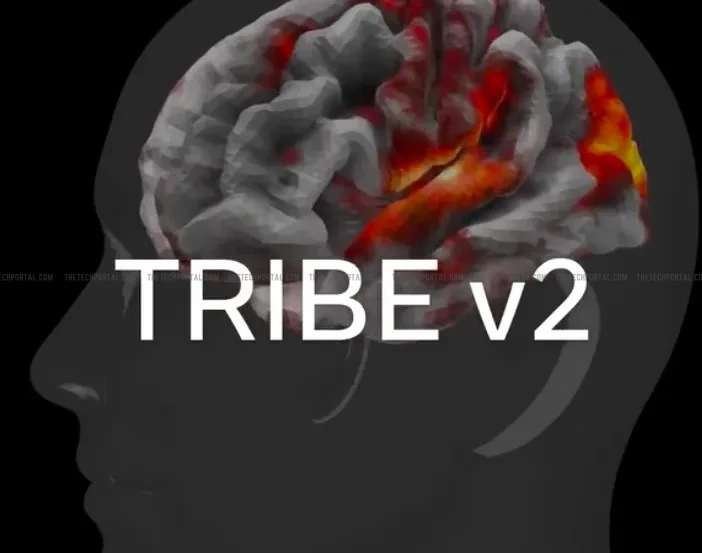

Meta has introduced TRIBE v2 (TRImodal Brain Encoder version 2), a next-generation multimodal AI system designed to predict human brain responses to real-world inputs like video, audio, and language. It is developed by Meta’s FAIR (Fundamental AI Research) team and uses transformer-based deep learning to connect sensory data with brain activity measured through fMRI scans. The model is trained on large-scale neuroscience datasets and aims to generalize neural prediction across individuals.
According to the social media giant, TRIBE v2 is part of its latest efforts toward computational neuroscience modeling. One of the key goals of TRIBE v2 is to move beyond traditional neuroscience models that focus on isolated sensory processing. At its core, the system functions as a multimodal brain-response model, meaning it processes multiple types of input simultaneously. Instead of analyzing only one kind of data at a time, the model integrates visual information from video frames, auditory signals from sound, and linguistic structure from text or transcripts. These modalities are then combined into a unified internal representation that is used to estimate how different regions of the human brain would respond under the same conditions.
Technically, the system relies on deep learning architectures, likely transformer-based neural networks, that are capable of handling sequential and multimodal data. These architectures are used to align patterns in sensory input with corresponding brain activity recorded through imaging techniques like fMRI. The model learns statistical relationships between what a person experiences and how their brain responds at a regional level.
The system builds on earlier iterations of Meta’s TRIBE framework, which already demonstrated the ability to map neural activity across large portions of the brain while participants were exposed to naturalistic stimuli like movie clips and continuous audio-visual content. And now, TRIBE v2 is described as a more advanced version, trained on a significantly larger dataset involving extended hours of recorded brain activity collected from multiple participants.
A major improvement in TRIBE v2 is its ability to generalize across different contexts and individuals. Earlier brain-modeling systems often struggled when exposed to new types of stimuli or when applied to people whose brain responses differed from the training dataset. However, the updated version is designed to reduce this limitation by learning more conceptual representations of perception and understanding rather than memorizing stimulus-specific patterns.
But despite such advancements, TRIBE v2 still has limitations and considerations. For example, fMRI data, which is widely used in neuroscience, has relatively low temporal resolution compared to the speed of actual neural firing, meaning the model works with indirect and averaged measurements of brain activity. Also, individual variability in cognition, attention, and emotional state can introduce noise that is difficult to fully capture. These factors mean that even advanced models like TRIBE v2 provide approximations rather than precise reconstructions of brain function.
The Tech Portal is published by Blue Box Media Private Limited. Our investors have no influence over our reporting. Read our full Ownership and Funding Disclosure →

Ashutosh is a Senior Writer at The Tech Portal, largely reporting on new tech, and intersection of technology and business. Ashutosh’s career spans across nearly a decade of technology writing across multiple platforms and languages.