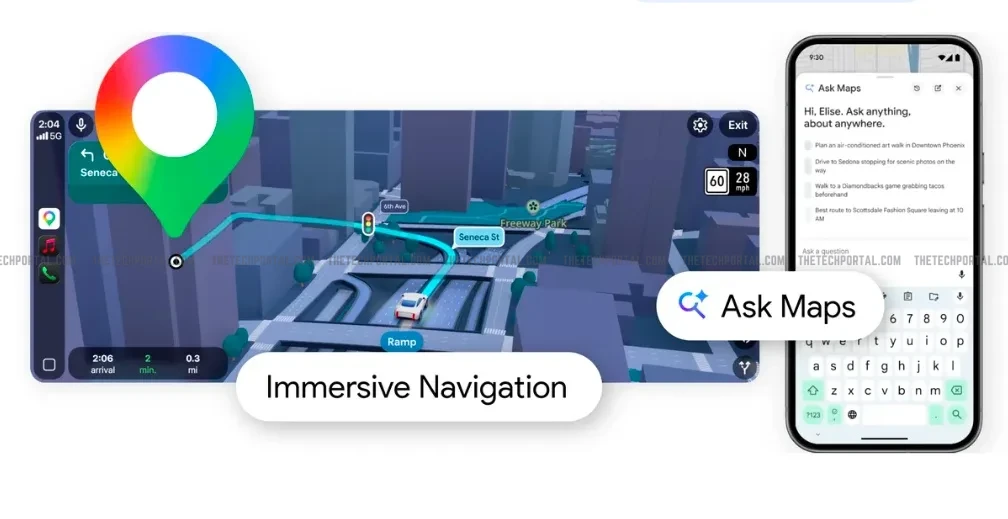

Google has announced a major update to Google Maps, introducing a new AI feature called ‘Ask Maps’ along with an upgraded immersive navigation experience. The update integrates the tech titan’s Gemini directly into the mapping service, allowing users to interact with Maps in a conversational way rather than depending only on traditional keyword searches.
The new Ask Maps feature allows users to type or speak natural language questions and receive detailed answers generated by Gemini using the massive location database inside Google Maps. Instead of searching for basic phrases, users can ask complex requests. The AI interprets the intent behind the request and responds with customized suggestions displayed directly on the map. These responses draw on Google Maps’ extensive database of businesses, photos, menus, operating hours, popularity patterns, and hundreds of millions of user reviews.
Most importantly, because the AI system is integrated directly into Maps’ own data ecosystem, the Sundar Pichai-led firm aims to reduce the risk of generative AI errors by using verified location data inside Maps for its answers instead of relying on information from the open web. The system also takes context into account when generating results. For example, the AI can consider user preferences, travel patterns, ratings, and other contextual signals to provide recommendations that are more personalized than standard search results.
Along with the AI search upgrade, the tech giant is rolling out a redesigned immersive navigation system intended to make driving directions easier to understand. Traditional navigation interfaces display routes on flat 2D maps, but the new system uses detailed 3D visualizations of real-world environments. Buildings, terrain, overpasses, and road structures appear in realistic 3D form while drivers follow directions. Intersections, lanes, traffic lights, crosswalks, and medians are also rendered with more detail.
The update also introduces more detailed route information during trip planning. Drivers will be able to see explanations for why a particular route is recommended, like whether it avoids traffic congestion, reduces toll costs, or shortens travel time. Additional features include guidance for locating parking near a destination and directions for the final walking segment once the vehicle is parked. The rollout of the new features will initially focus on mobile devices running Android and iOS, with early availability expected in markets including the United States and India before broader international expansion.
The Tech Portal is published by Blue Box Media Private Limited. Our investors have no influence over our reporting. Read our full Ownership and Funding Disclosure →

Ashutosh is a Senior Writer at The Tech Portal, largely reporting on new tech, and intersection of technology and business. Ashutosh’s career spans across nearly a decade of technology writing across multiple platforms and languages.