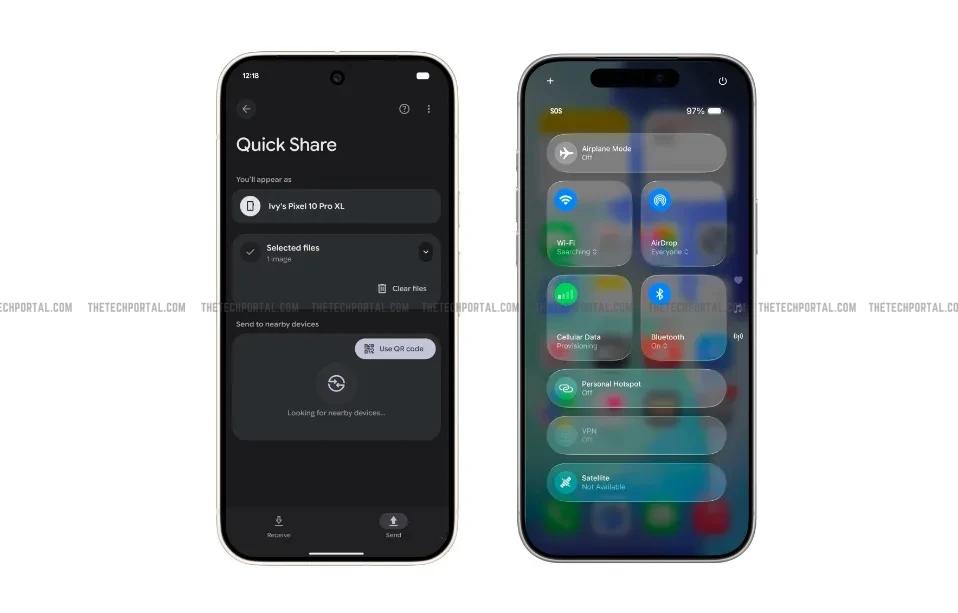

Google is preparing to expand AirDrop support to more Android phones in the near future. The company has confirmed that support for direct AirDrop interoperability, first introduced on the Google Pixel 10 series in 2025, will expand to many more Android devices very soon, reports Android Authority, citing a recently held press briefing. Although the tech giant has not confirmed which brands or models will be first to receive the expanded support, expectations are high that devices powered by recent Snapdragon and other mainstream chipsets will be included early.
At the center of this expansion is Quick Share, Google’s native file-sharing system for Android. Quick Share evolved from Nearby Share and relies on a combination of Bluetooth discovery and high-speed peer-to-peer Wi-Fi connections to move files between nearby devices. In its most recent iteration, the Sundar Pichai-led firm quietly added the ability for Quick Share to communicate directly with Apple’s AirDrop protocol. This means Android phones can send photos, videos, documents, and other files straight to iPhones, iPads, and Macs without uploading anything to the cloud or installing third-party apps. Transfers happen locally, preserving speed and privacy while avoiding data caps and internet dependency.
So far, this AirDrop compatibility has been available only on Google’s latest Pixel hardware (Pixel 10 series), where it has served as a proof of concept. According to Google, that limited rollout was intentional. Engineers first focused on ensuring reliable performance across Apple’s device lineup, including macOS laptops and tablets running iPadOS, while also addressing security, encryption, and user-permission controls. With those technical hurdles largely resolved, the tech behemoth states it is now working closely with Android phone manufacturers to bring the feature to a much wider range of devices.
From a technical perspective, the feature is expected to rely on hardware that is already present in most modern Android phones. Wi-Fi Direct support, Bluetooth Low Energy, and recent versions of Android’s networking stack are key requirements, which suggests that many mid-range and flagship phones released in the last few years could be eligible. The update itself is likely to arrive through Google Play system components or Quick Share updates rather than full operating-system upgrades.
At the same time, security and privacy have been highlighted as central design priorities. Like Apple’s AirDrop, Quick Share’s cross-platform transfers require user approval before any file is sent, and connections are established only when devices are nearby. Files move directly between devices over encrypted local links, rather than passing through Google or Apple servers.
This expansion has broader implications for the Android ecosystem. Android devices account for around 70% of global smartphone shipments, while Apple dominates markets like the United States and parts of Europe. And historically, file sharing between these platforms has been difficult, often forcing users to depend on messaging apps, email, or cloud storage links to move a few photos.
The Tech Portal is published by Blue Box Media Private Limited. Our investors have no influence over our reporting. Read our full Ownership and Funding Disclosure →

Ashutosh is a Senior Writer at The Tech Portal, largely reporting on new tech, and intersection of technology and business. Ashutosh’s career spans across nearly a decade of technology writing across multiple platforms and languages.