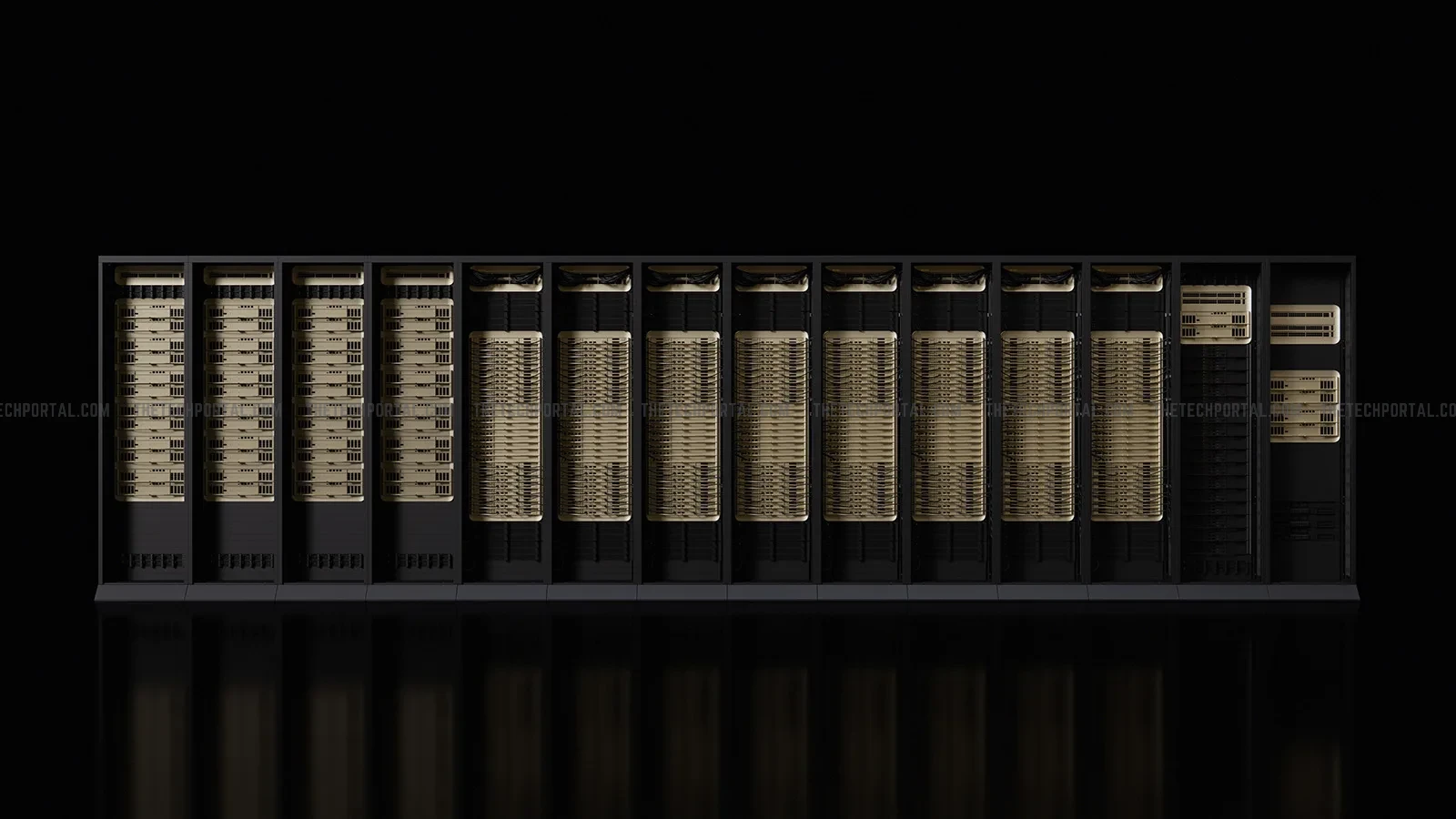

Nvidia used the Consumer Electronics Show (CES) in Las Vegas to formalize its next major step in data-center computing, announcing that its Rubin architecture is now in production and scheduled for customer deployment in the second half of the year. Nvidia chief Jensen Huang said all six chips that make up the Rubin platform have returned from manufacturing partners, positioning the company to address the mounting demand for AI infrastructure.
The announcement comes as cloud providers and AI developers face growing strain from increasingly complex models that require more compute, memory, and interconnect capacity than earlier generations of hardware were designed to handle. Nvidia, which dominates the market for AI accelerators, is seeking to maintain that position amid intensifying competition and rising scrutiny of long-term spending levels. “CES—NVIDIA today kickstarted the next generation of AI with the launch of the NVIDIA Rubin platform, comprising six new chips designed to deliver one incredible AI supercomputer. NVIDIA Rubin sets a new standard for building, deploying and securing the world’s largest and most advanced AI systems at the lowest cost to accelerate mainstream AI adoption,” the company announced in an official statement.

Unlike earlier launches centered primarily on a flagship GPU, Rubin is a co-designed system that combines six specialized chips into what Nvidia describes as a single computing platform. At its center is the Rubin GPU, supported by the new Vera CPU, NVLink sixth-generation switching, ConnectX-9 networking, BlueField-4 data processing units, and Spectrum-X Ethernet components. Nvidia says this architecture delivers roughly three-and-a-half times the training performance and five times the inference throughput of Blackwell-based systems, while reducing energy consumption per inference task.
Huang said demand for Rubin-class systems is already strong, driven largely by a small group of cloud providers whose capital spending now accounts for the majority of Nvidia’s data-center revenue. Microsoft, Amazon Web Services, and Google Cloud are expected to be among the earliest adopters, alongside specialized AI infrastructure firms. Still, this comes at a time when geopolitical constraints remain a structural factor in Nvidia’s outlook, particularly as demand in China remains strong for export-compliant accelerators such as the H200. The company has submitted license applications to U.S. authorities for certain products and has said that approved shipments will not disrupt supply to other regions.
“Intelligence scales with compute. When we add more compute, models get more capable, solve harder problems and make a bigger impact for people. The NVIDIA Rubin platform helps us keep scaling this progress so advanced intelligence benefits everyone,” Sam Altman, OpenAI CEO, commented on the matter.
Alongside Rubin, Nvidia used CES to promote tools aimed at expanding AI adoption beyond cloud data centers, including platforms for robotics, autonomous vehicles, and industrial automation. The company argues that advances in hardware efficiency are necessary to make AI viable in environments with tighter power and cost constraints. Whether Rubin’s gains translate into sustained revenue growth will depend on customer uptake, supply chain execution, and the ability of Nvidia’s software stack to maintain its central role in AI development. For now, the company is betting that deeper integration across hardware, networking, and software will keep it at the center of the AI infrastructure build-out.
The Tech Portal is published by Blue Box Media Private Limited. Our investors have no influence over our reporting. Read our full Ownership and Funding Disclosure →