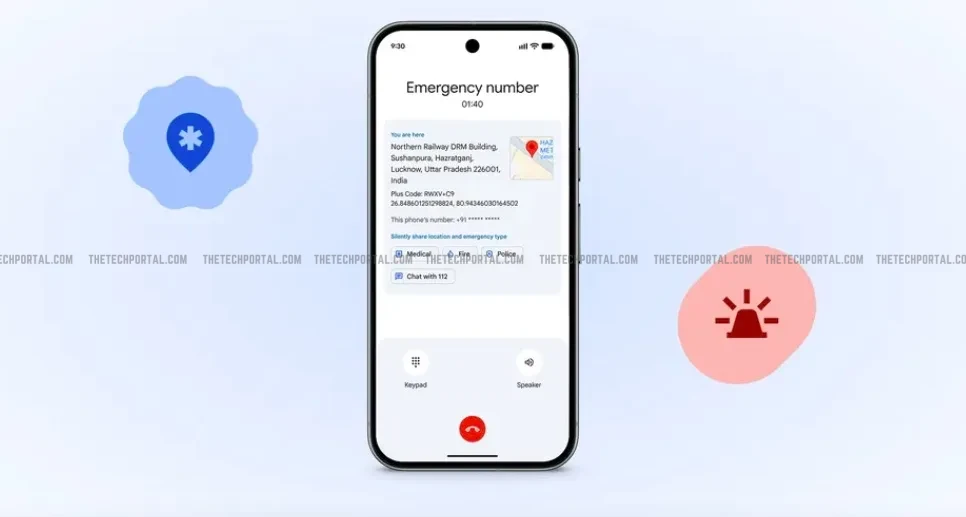

Google is bringing a critical safety feature to India with the rollout of its Emergency Location Service (ELS) for Android smartphones, starting with the northern state of Uttar Pradesh. The feature allows Android devices to automatically transmit a caller’s precise location to emergency responders when dialling or messaging 112, India’s national emergency number. I
ntegrated at the operating system level and available on Android 6.0 and newer, ELS works without requiring user setup or third-party apps, using a mix of GPS, Wi-Fi, and cellular data to help authorities locate callers faster. It is designed to continue transmitting useful location data even if emergency calls are short or disconnected.
The service has been integrated with UP112, Uttar Pradesh’s centralized emergency response system that coordinates police, ambulance, and fire services across the state. With ELS in place, emergency control rooms receive real-time location data directly from a caller’s phone, reducing dependence on verbal directions that can often be unclear and incomplete during high-stress situations. This is particularly valuable in emergencies involving injuries, panic, language barriers, or unfamiliar surroundings, where callers may struggle to explain their exact location.
During its pilot phase in Uttar Pradesh, ELS supported more than 20 million emergency calls and SMS interactions, demonstrating its ability to operate at scale in one of India’s most populous regions. Importantly, location accuracy can typically narrow down a caller’s position to within around 50 metres, a significant improvement over older cell-tower-based methods.
The technology behind ELS relies on Android’s fused location framework, which intelligently combines multiple data sources to determine the most accurate location available at that moment. Whether a user is indoors, outdoors, or in a moving vehicle, the system dynamically selects the best signals to generate reliable results. Notably, ELS activates only during emergency interactions and remains inactive during normal phone use.
“In the 60+ countries where the service is operational, it has consistently expedited emergency response times, enabling emergency services to reach people in need and distress faster,” the company noted.
In terms of privacy, which has always been a controversial topic for tech giants like Google, the company has stressed that strong safeguards are built into the Emergency Location Service. According to the Mountain View-headquartered company, it does not store, track, or retain emergency location data generated through ELS. The location information is shared only with authorized emergency responders and only during an active emergency call or message to 112. Once the interaction ends, the system automatically stops transmitting location data.
The Tech Portal is published by Blue Box Media Private Limited. Our investors have no influence over our reporting. Read our full Ownership and Funding Disclosure →

Ashutosh is a Senior Writer at The Tech Portal, largely reporting on new tech, and intersection of technology and business. Ashutosh’s career spans across nearly a decade of technology writing across multiple platforms and languages.