Weeks after it forced OpenAI to declare an official ‘Code Red’, Google is pushing the pace of its AI rollout even further with Gemini 3 Flash, a new model now deployed as the default across the Gemini app. The update quietly replaces the previous Flash model but represents a meaningful jump in capability, speed, and efficiency for everyday users, says Google.
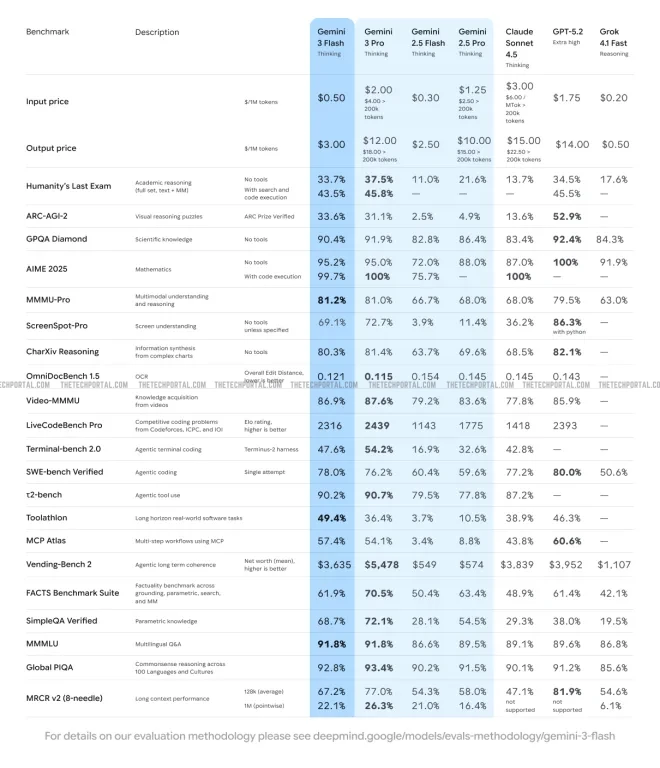
Gemini 3 Flash is designed to deliver fast, multimodal AI responses while still handling complex reasoning and coding tasks. The tech titan is positioning the Gemini 3 Flash as a model that can scale to massive consumer use without the latency and cost typically associated with top-tier AI systems. The move also comes as competition between Google and OpenAI continues to intensify, with Google pointing to benchmark results showing that Gemini 3 Flash matches and, in some cases, outperforms GPT-5.2 on select tests.
At its core, Gemini 3 Flash reflects Google’s growing focus on performance-per-dollar rather than raw model size. The model is optimized for low latency, allowing it to respond significantly faster than earlier Flash versions while preserving advanced reasoning capabilities. This makes it particularly well-suited for conversational use, quick problem-solving, real-time assistance, and short-form coding help – use cases that dominate how most people interact with AI on a daily basis. By making Gemini 3 Flash the default, the Mountain View-headquartered company is effectively upgrading the baseline AI experience for users without requiring them to choose and understand different model tiers.
Gemini 3 Flash also brings strong multimodal capabilities to the forefront. The model can natively understand and reason across text, images, audio, and video, enabling users to upload photos, screenshots, diagrams, or short clips and receive structured explanations and insights. Cost efficiency is also a key pillar of the launch. For developers accessing Gemini 3 Flash through the Gemini API and Vertex AI, the model is priced substantially lower than many high-end competitors, with input and output token costs designed to support large-scale deployments
On the technical front, the Sundar Pichai-led firm says Gemini 3 Flash delivers roughly a threefold improvement in speed compared to the previous Flash generation. In tests that evaluate deep reasoning and factual knowledge, Gemini 3 Flash lands close to leading frontier models, while on certain multimodal reasoning benchmarks, it edges ahead of GPT-5.2. These results suggest that Google has narrowed the performance gap without relying on heavier, slower architectures, strengthening its claim that Flash is no longer a lightweight option.
The rollout extends well beyond consumer-facing apps. Gemini 3 Flash is being integrated across Google’s developer ecosystem, including Google AI Studio, Android Studio, command-line tools, and enterprise platforms. The latest move highlights the intense challenges and competition Google is facing in the race for AI dominance, particularly from heavyweight competitors like OpenAI. Users now compare AI assistants side-by-side and expect not just accuracy, but speed, consistency, and reliability – raising the bar for every release.
The Tech Portal is published by Blue Box Media Private Limited. Our investors have no influence over our reporting. Read our full Ownership and Funding Disclosure →

Ashutosh is a Senior Writer at The Tech Portal, largely reporting on new tech, and intersection of technology and business. Ashutosh’s career spans across nearly a decade of technology writing across multiple platforms and languages.