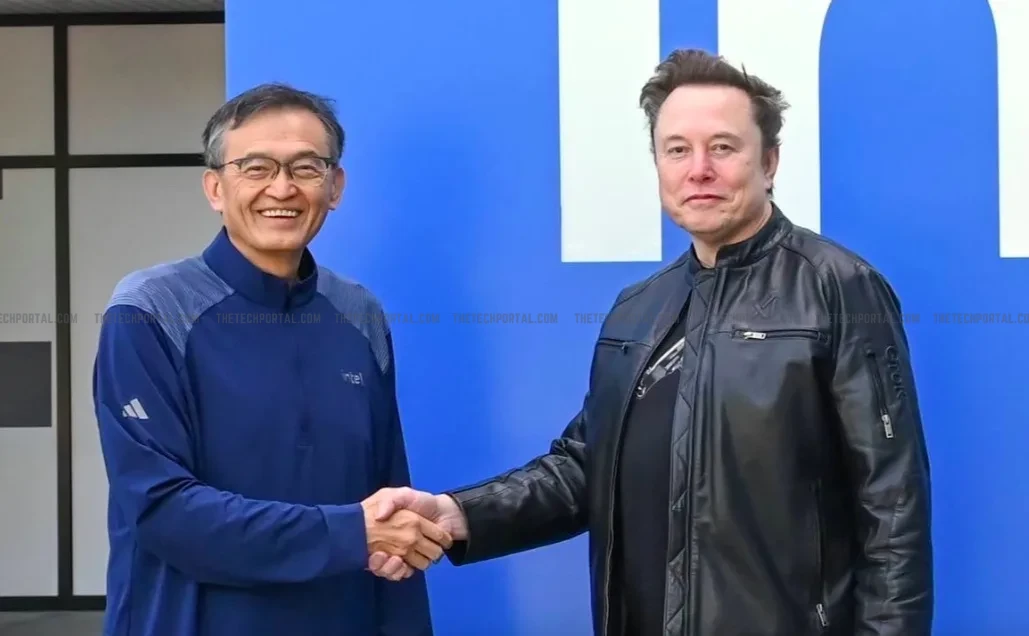
Intel has joined Elon Musk’s Terafab initiative, teaming up with Tesla, SpaceX, and xAI to build a tightly integrated, next-generation chip manufacturing ecosystem. The project aims to centralize everything from chip design to fabrication and packaging, and is designed to produce AI processors at an unprecedented scale – targeting up to a terawatt of compute capacity annually. Intel’s role will focus on providing advanced chip manufacturing expertise, positioning it as a key manufacturing partner in powering Musk’s expanding AI and robotics ambitions.
“Our ability to design, fabricate, and package ultra-high-performance chips at scale will help accelerate Terafab’s aim to produce 1 TW/year of compute to power future advances in AI and robotics,” the semiconductor giant said.
Notably, Terafab aims to transform how semiconductor chips are produced by bringing design, manufacturing, packaging, and testing into a single integrated facility, instead of relying on a global network spread across the United States, Taiwan, and South Korea. The move comes at a time when demand for AI computing power is rising sharply, driven by technologies like generative AI, large language models, and autonomous systems.
Currently, companies like Nvidia dominate AI chip design, while manufacturers like TSMC play a central role in production. Therefore, Terafab is positioned as an effort to challenge this model by creating a high-capacity, end-to-end system capable of producing advanced AI chips more efficiently and at scale. Financially, early estimates suggest an initial investment in the range of $20-25 billion, with the potential for significantly higher capital requirements as the project expands.
And now, Intel’s participation is seen as a crucial boost to the project, given its deep expertise in chip manufacturing and its push to regain leadership in advanced technologies. The company has been investing in next-generation processes like 18A and advanced packaging methods that combine multiple chip components into high-performance units. By partnering with Musk’s ecosystem, Intel not only secures strong demand from companies like Tesla and xAI but also strengthens its position in the fast-growing AI hardware market, which is expected to reach hundreds of billions of dollars in the coming years.
For Musk’s companies, the latest deal helps connect hardware and AI more tightly. Tesla is already building custom chips for self-driving and robots like Optimus, while xAI is developing large AI models that need huge computing power. SpaceX adds to the plan with ideas for space-based data centers using solar energy and natural cooling. Together, this increases demand for highly efficient, specialized chips that Terafab aims to produce at scale.
However, the development comes at a crucial time for Intel, which has been under financial pressure despite strong industry backing. Last year, Nvidia invested about $5 billion in Intel, taking over a 4% stake, while the US government also acquired a 10% stake through an $8.9 billion investment under federal chip programs. Despite this support, Intel reported a 4% drop in revenue to around $13.7 billion and a net loss of about $591 million in Q4 FY2025.
The Tech Portal is published by Blue Box Media Private Limited. Our investors have no influence over our reporting. Read our full Ownership and Funding Disclosure →

Ashutosh is a Senior Writer at The Tech Portal, largely reporting on new tech, and intersection of technology and business. Ashutosh’s career spans across nearly a decade of technology writing across multiple platforms and languages.