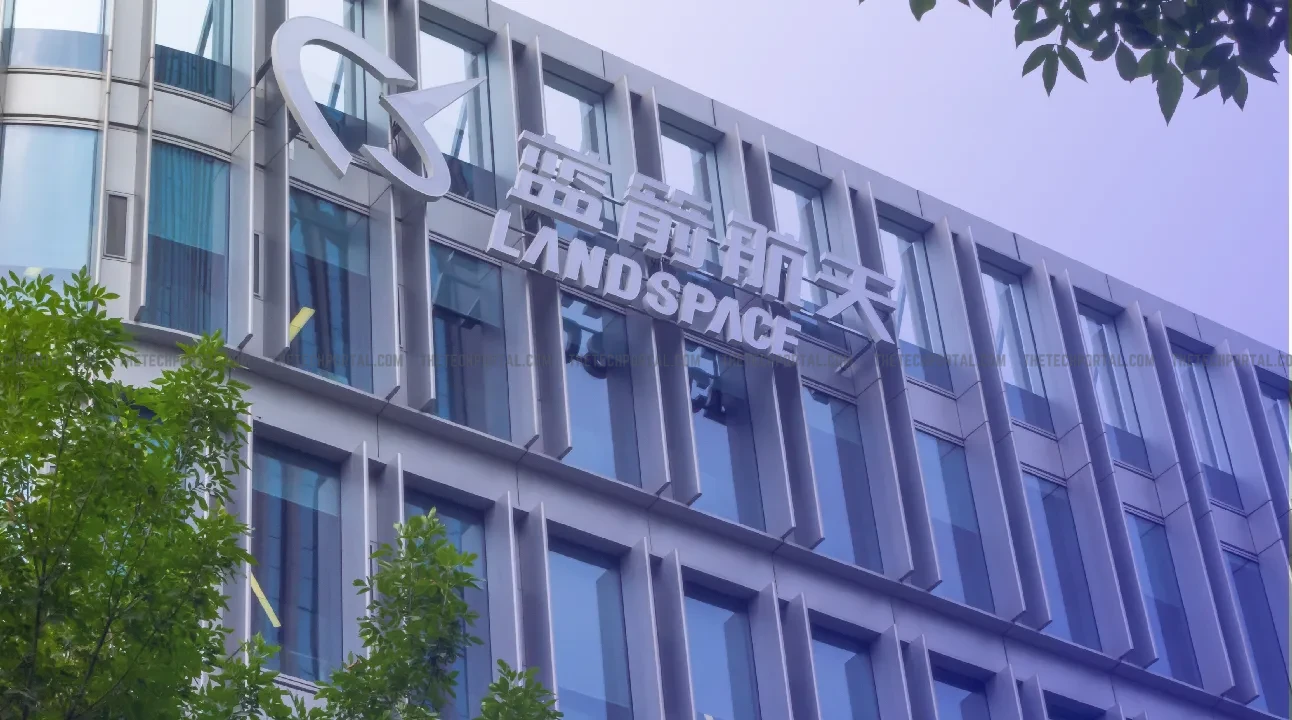
China is now making a bid into the reusable rocket sector, and Beijing-based startup LandSpace seems to be its first bid, marking a pivotal moment in the country’s commercial space ambitions. Its Zhuque-3 launch vehicle, though unsuccessful in its latest test, represents China’s most direct private-sector challenge yet to SpaceX’s Falcon 9.
LandSpace’s leadership openly credits SpaceX as a reference point. Zhuque-3 chief designer Dai Zheng said SpaceX’s ability to push systems “to the edge and even into failure” was a factor in his decision to leave China’s primary state rocket developer in 2016. This mindset — learning through failure rather than avoiding it — runs counter to decades of China’s state-led space doctrine in a sector that has long been dominated by state-owned firms.

Zhuque-3’s most recent test failed when its booster was unable to ignite a landing burn roughly three kilometres above ground, resulting in a crash rather than a controlled descent. LandSpace has framed the outcome as a data-rich step toward eventual reuse, drawing parallels to SpaceX’s own early Falcon booster failures. For reference, SpaceX achieved its first successful Falcon 9 landing in 2015, after two failed attempts.
Zhuque-3 deliberately mirrors the architecture of SpaceX’s Falcon 9, a choice LandSpace frames as engineering pragmatism rather than imitation. Deputy chief designer Dong Kai described Falcon 9 as a “successful configuration tested by engineering,” arguing that adopting proven designs is rational in pursuit of lower launch costs. The rocket incorporates stainless steel structures and methalox engines.
For those who are unaware, the Falcon 9 uses a kerosene-based RP-1 system. While kerosene is easier to handle, it is notorious for “coking”—the buildup of carbon soot inside engine cooling jackets and injectors during combustion. This soot is the primary enemy of reusability, requiring intensive and costly cleaning between launches. Methane, by contrast, burns remarkably clean, leaving virtually no residue. This lack of soot allows for a “gas-and-go” refurbishment model that slashes the turnaround time and maintenance costs.
Even Elon Musk has taken notice. Commenting publicly on Zhuque-3’s design, Musk acknowledged the blend of Falcon 9 and Starship concepts, while adding that SpaceX’s Starship remains “in another league.” “They have added aspects of Starship, such as use of stainless steel and methalox, to a Falcon 9 architecture, which would enable it to beat Falcon 9,” Musk had commented on the matter earlier this year. “But Starship in another league.”
This development is new, and Beijing seems to be easing pathways for private space firms to access public markets as a response to the capital-intensive nature of reusable rocketry. As per media reports, LandSpace is preparing for a public listing of its own, aligning its funding strategy with the same capital-market logic that enabled SpaceX to absorb repeated losses during development. It remains to be seen whether the development of the Zhuque-3 will position LandSpace as the primary heavy-lifter for China’s upcoming satellite networks: the state-led “Guowang” (National Network) and the Shanghai-backed “G60 Starlink” (now often referred to as Qianfan or “Thousand Sails”). These projects, which aim to deploy nearly 25,000 satellites combined, seem to be Beijing’s answer to the leverage afforded by SpaceX’s Starlink.
The Tech Portal is published by Blue Box Media Private Limited. Our investors have no influence over our reporting. Read our full Ownership and Funding Disclosure →