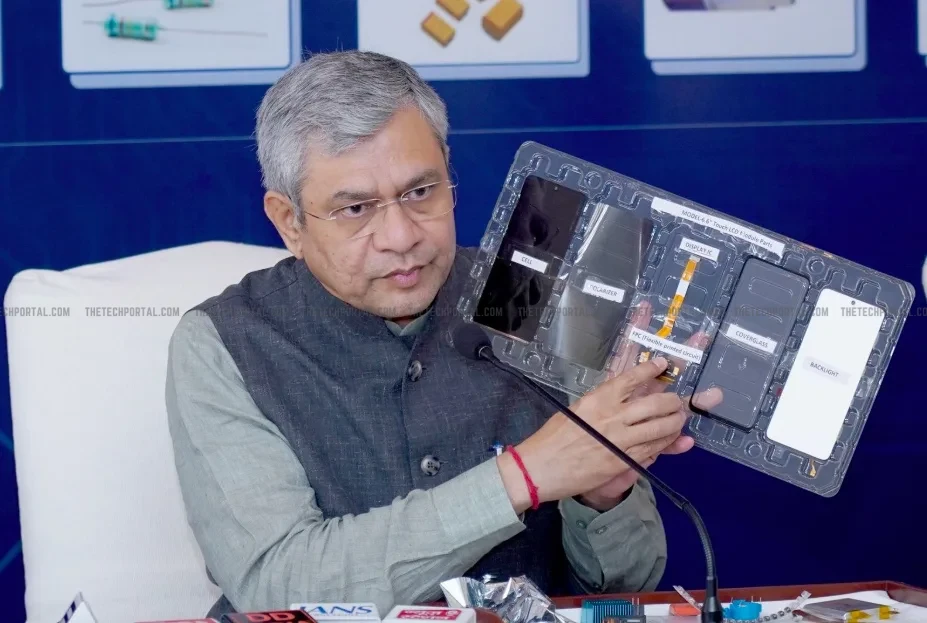

India has approved 29 new projects under the Electronics Component Manufacturing Scheme (ECMS), with a total investment of ₹7,104 crore (~ $751 million). The latest approvals focus on building domestic capacity in key components like display modules, telecom equipment, and other electronics parts. This comes just months after the government cleared projects worth around ₹41,863 crore (~ $4.6 billion) to boost local production of critical components used in smartphones and other electronic devices.
“75 projects approved under ECMS so far, with ₹61,671 crore investment and 65,000 jobs,” Ashwini Vaishnaw (Minister, Electronics & Information Technology) noted.

The 29 approved projects span multiple segments of the electronics value chain, including consumer electronics, telecom infrastructure, automotive electronics, and industrial hardware. This diversification is critical, as it ensures that the domestic ecosystem develops across sectors rather than remaining concentrated in a single category like mobile phones. Industry participation in the scheme has also broadened, with both established manufacturers and new entrants committing investments in technologically advanced areas.
Among the notable developments, leading contract manufacturer Dixon Technologies is expected to invest in display module manufacturing, a segment that accounts for a substantial share of the cost of devices like smartphones and televisions. In another strategic move, Lohum Cleantech has received approval to manufacture rare-earth permanent magnets, key components used in electric vehicles, electronics, and clean energy technologies. This project is particularly significant because it represents one of India’s early efforts to produce such magnets domestically from rare-earth materials.
The government has also introduced a stricter framework for availing incentives under the scheme. Companies are now expected to develop design and engineering capabilities within India, in addition to setting up manufacturing units. This ‘design-led manufacturing’ approach marks a shift from earlier policies that primarily rewarded production scale. By linking incentives to innovation, the government aims to ensure that more value addition, intellectual property creation, and technological expertise are built within the country.
Notably, the ECMS is part of a broader policy push to scale up India’s electronics manufacturing industry. In the financial year ending March 2025, India’s electronics production was valued at about $125 billion. And now, the government has set a target of reaching $500 billion in electronics output by fiscal year 2031, driven by a combination of incentive schemes, infrastructure investments, and regulatory reforms.
All these efforts become even more crucial as China is also tightening its technology and manufacturing ecosystem. In December 2025, the country mandated that chipmakers setting up or expanding fabrication plants must source at least 50% of their equipment from domestic suppliers, while also rolling out state-backed funds worth over 150 billion yuan (~ $21 billion) to support hard-technology sectors.
The Tech Portal is published by Blue Box Media Private Limited. Our investors have no influence over our reporting. Read our full Ownership and Funding Disclosure →