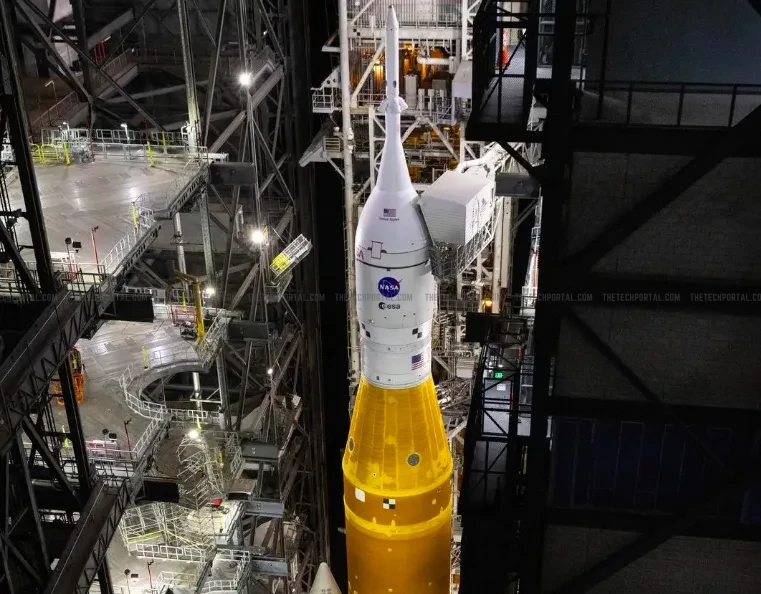

NASA has updated its Moon mission timeline. The agency has revised its Artemis program, moving the first planned crewed lunar landing to 2028. Initially, Artemis III was expected to carry astronauts to the Moon’s surface. However, the mission will now focus on testing key systems in orbit, including docking with a lunar lander and checking new life-support equipment and spacesuits. The actual landing will instead take place under Artemis IV. By adding another step, NASA hopes to reduce technical risks and avoid problems during the landing mission.
Under the revised plan, Artemis II will remain the first crewed flight of NASA’s deep-space exploration system. That mission will send four astronauts around the Moon and back to Earth, testing the Space Launch System (SLS) rocket and the Orion spacecraft with crew onboard for the first time. Artemis II will validate life-support systems, deep-space navigation, high-speed lunar re-entry procedures, and long-duration crew operations beyond low Earth orbit.

The most notable shift affects Artemis III. Rather than attempting a lunar landing, Artemis III will now serve as a systems validation mission in Earth orbit. Astronauts will rehearse rendezvous and docking manoeuvres with a commercially built Human Landing System (HLS), test upgraded spacesuits designed for lunar surface activity, and verify life-support technologies intended for deep-space operations. By separating these technical demonstrations from the landing itself, NASA aims to avoid stacking too many first-time objectives onto a single high-stakes mission.
Importantly, the lunar landing itself is now assigned to Artemis IV, targeted for 2028. This mission is expected to send astronauts to the Moon’s south polar region – an area of intense scientific interest due to evidence of water ice trapped in permanently shadowed craters. Water ice could be processed into drinking water, breathable oxygen, and even rocket propellant, making it a key part of NASA’s long-term plan to build sustainable infrastructure on and around the Moon.
The Artemis architecture relies heavily on partnerships with industry and international allies. Along with Boeing and Lockheed Martin, which build the SLS rocket and the Orion spacecraft, respectively, NASA has tapped commercial firms like SpaceX and Blue Origin to develop human lunar landers. SpaceX’s Starship design was initially selected for early Artemis missions, while Blue Origin’s Blue Moon vehicle is planned for later flights. When NASA’s first Artemis test mission launched in 2022 – an uncrewed flight of SLS and Orion around the Moon – it marked the first integrated test of these systems and set the stage for more complex lander and crewed missions to follow. Meanwhile, the latest developments have become even more notable as China has also announced ambitions to send its own astronauts to the Moon around 2030.
The Tech Portal is published by Blue Box Media Private Limited. Our investors have no influence over our reporting. Read our full Ownership and Funding Disclosure →